
Enterprise AI
AI Equipment Fault Diagnosis: Getting Veteran Technicians' Know-How into Work Orders
Manufacturers can hand first-pass fault diagnosis to AI. The lasting gain is logging veteran technicians' verified fixes in work orders as searchable knowledge.
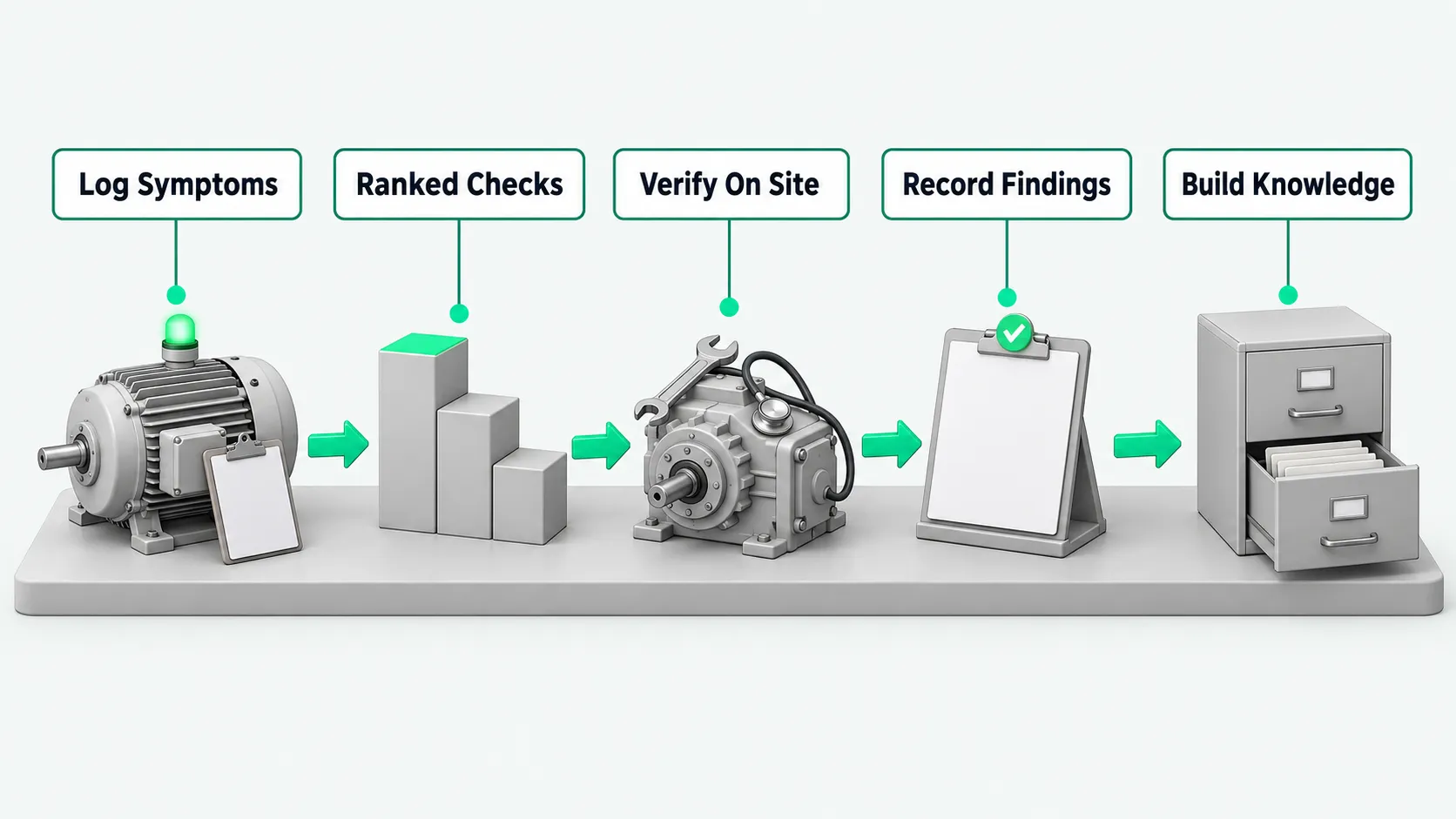
AI-assisted fault diagnosis speeds up first-pass troubleshooting. Whether field experience gets captured depends on the work order write-back loop. A model can infer likely causes from sensor alarm codes and equipment manuals. It cannot replace a veteran technician’s judgment on vibration, abnormal noise, part wear, and assembly clearances. The standard practice in industrial plants: operators log symptoms in a fixed format, the AI returns candidate causes and troubleshooting steps, a veteran technician verifies them on site and corrects them by hand, and the cleaned-up record becomes a knowledge entry for the next diagnosis.
Fault Reporting and Symptom Description: Capture Multi-Source Anomaly Data in a Standard Format
When a production line stops unexpectedly, the data gateway and the shift operator record the anomaly data together.
After a machine tool alarms and stops, the gateway captures the metrics from a window before the stop: motor current, hydraulic pressure, spindle speed, and bearing temperature curves. It saves them in one package with the alarm code. The shift operator files the fault report on a handheld terminal, selects the affected part of the machine, and checks off symptoms such as unusual smell, squealing, or oil leaks.
This step belongs to the operator. The operator adds details by voice input on the terminal, including what workpiece material the machine was cutting when the fault occurred. The system binds the sensor data to the text description and generates a report batch number. The gateway sends the package to the inference engine as input for the next step.
Inferring Causes and Check Order: Output Recommendations Ranked by Risk
The model searches equipment technical specifications and similar past cases, then outputs a list of candidate causes and a troubleshooting path.
After reading the report data, the model pulls drawings and maintenance history and infers several possible fault sources. It orders the troubleshooting steps by how hard the part is to replace and how likely the failure is: external fuses and sensors first, internal modules in the cabinet after. For the engineering practice of pulling production drawings and context into the model on demand, see Enterprise Context Engineering: Making Company Knowledge Usable by AI Agents.
Safety control at this step belongs entirely to qualified engineers. The system tags each item on the list with a safety level. For any operation that involves cutting main power, lockout/tagout (LOTO), live measurement, or removing load-bearing piping, the model only lists the key points. Authority to permit the work stays with the shift supervisor. The inference engine pushes the recommendations to the maintenance technician’s handheld terminal.
On-Site Verification and Rejected Hypotheses: Record Where the Technician’s Senses and Measurements Differ
A senior technician arrives at the machine with measuring instruments, checks the model’s inferences, and rejects the ones that do not fit.
The technician compares the list against the machine’s actual condition, item by item. The model might infer from current fluctuations that the spindle motor has failed. The veteran, listening to the machine and turning it over by hand, finds that a cracked bearing in the belt tensioner pulley is causing a jam. The technician tags the model’s candidate hypotheses on the handheld terminal, marks motor failure as ruled out, and creates a new confirmed finding: mechanical drive component jam. Before starting work, the technician performs and confirms lockout/tagout by hand.
This step is where experience shows. A veteran identifies the failed part and can also spot intermittent faults caused by heat buildup or degraded grease. The technician records exact clearance values from gauges, which fills in conditions the system cannot observe. When troubleshooting is done, the technician checks off the confirmed root cause and moves on to part replacement and the work order write-back.
Writing Back Findings as Structured Records: Log Root Cause and Reconcile Spare Parts Use
After the repair, the technician fills in a root cause analysis on the work order and records any process adjustments.
The technician enters the replaced parts’ batch numbers, specifications, and the vibration readings from the test run. The technician also dictates a short voice note on the handheld about assembly details for this job, for example that a certain model of seal needs a thin coat of grease before pressing in so it does not twist. For how to weigh building a knowledge base against adopting a vertical industry model, see Fine-Tuning vs. RAG: Connect the Enterprise Knowledge Base First.
At this step, a parsing program does the semantic extraction. It reads the technician’s voice transcript and the checked items, extracts four standard fields (failed part, failure mechanism, corrective action, and spare parts used), and compares them against the model’s original recommendation. After the maintenance manager signs off, the work order record is formally archived in the production system.
Periodic Review and Knowledge Entries: Turn Representative Cases into Knowledge Assets
The plant’s technical review committee periodically reviews archived work orders and turns non-standard fixes into standard knowledge entries.
The maintenance manager runs technical review meetings with veteran technicians and process engineers. The team pulls difficult work orders and focuses on cases where the model’s diagnosis was wrong and a person overruled it. Engineers drop routine consumable replacements, keep the cases that teach something, and replace the shop-floor nicknames in veteran technicians’ notes with standard engineering terms.
A knowledge-capture program helps with the summarizing. It turns the reviewed cases into Q&A pairs and branches of a troubleshooting tree, then updates the vector search index. New entries take effect after the technical manager signs them electronically. The updated knowledge base is reattached to the diagnosis service so the model can reason correctly the next time it sees the same type of anomaly.
Equipment Fault Diagnosis: FAQ
Can the model issue instructions directly for operations involving personal safety or high voltage?
No. The model does not issue instructions for high-risk operations. High-voltage electrical maintenance, confined-space work, and heavy machinery disassembly are high-risk tasks that require a strict human sign-off process. The model’s role is limited to retrieving technical drawings and offering theoretical troubleshooting suggestions. Cutting main power, lockout/tagout, voltage testing and discharge, and issuing permits-to-work are the responsibility of qualified safety officers and lead technicians on site. This keeps model errors from causing accidents.
Veteran technicians write up troubleshooting in shop-floor slang. How does the system handle informal wording?
The system builds a dictionary that maps shop-floor slang to standard industry terms and converts in two passes. In the first pass, a language model reads the technician’s dictated notes and uses the specific machine part to identify which component the slang refers to. In the second pass, the plant’s technical manager spot-checks and corrects the results during periodic reviews, then converts confirmed entries to standard engineering terms. Technicians keep recording quickly on site, and the knowledge base stays standardized.
During a digitalization push, how do you get veteran technicians to fill in work orders with root causes?
Reduce the typing burden on veteran technicians. Provide photo recognition, voice dictation, and checkbox options on the handheld terminal, so a technician only needs to talk through the reasoning on site and photograph the failed part. Set up an incentive for knowledge contributions: when a veteran’s troubleshooting notes are accepted into the official knowledge base and later help shorten downtime on other work orders, the system credits the contribution in performance reviews with recognition and rewards. This gives senior staff a reason to record what they know.