
Enterprise AI
Near-Miss Grading: Who Runs the Investigation?
After shop-floor workers report a near-miss incident, tools suggest EHS grading by potential consequence for a safety engineer to confirm, routing high-grade cases to EHS and workshop heads.
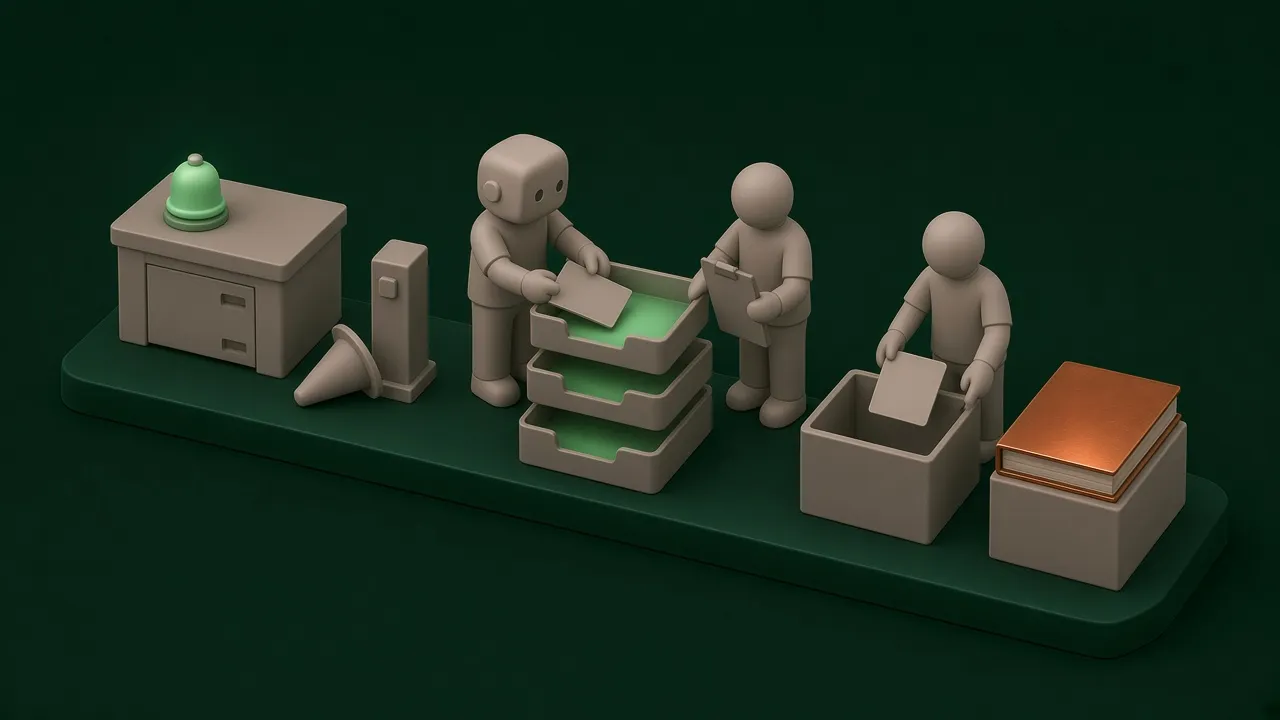
After a near-miss incident is reported, it first goes through EHS grading based on potential consequences, and a safety engineer confirms the grade before deciding whether the safety department leads an investigation or the shift supervisor handles it on shift. OSHA’s incident investigation guide for employers defines a near-miss incident as an occurrence that could have caused a serious injury or illness but did not, also called a close call; the guide strongly encourages employers to investigate all workplace incidents, both those that cause injuries and near-miss incidents that could have caused harm under slightly different circumstances. Workers who report incidents are not penalized for coming forward, and investigations focus on finding and correcting root causes.
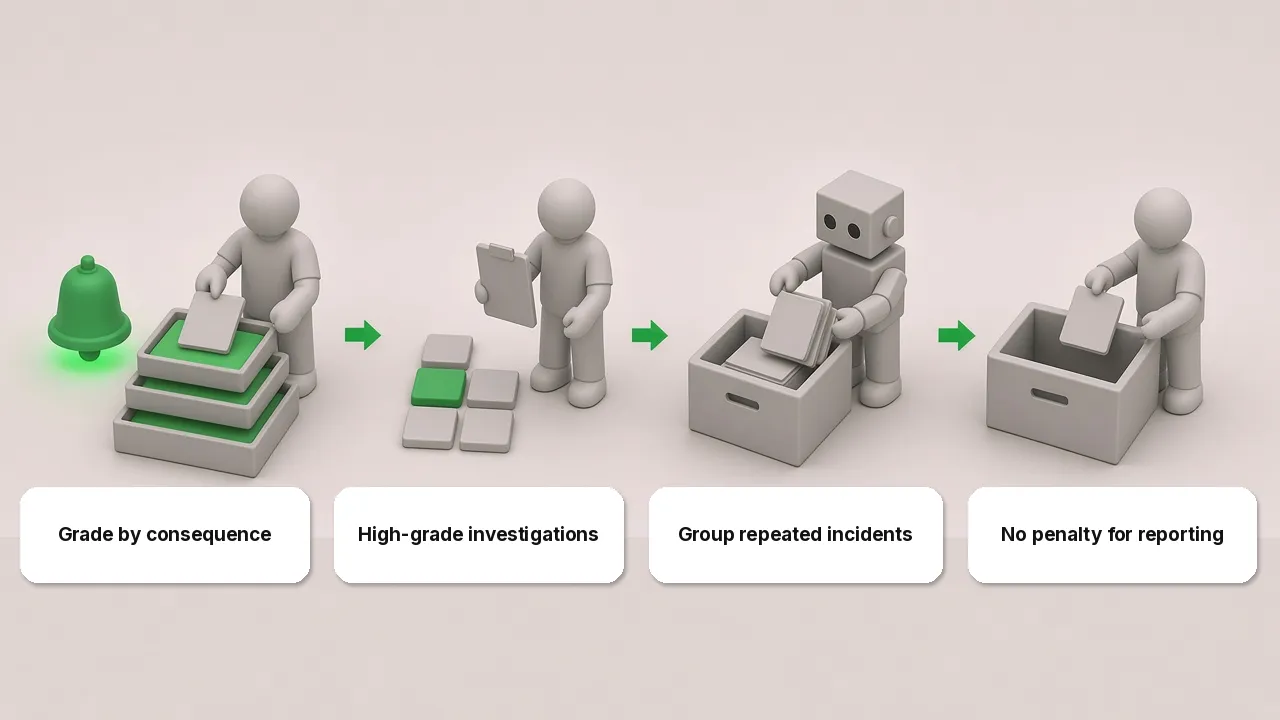
Grading by potential consequence and safety review
OSHA’s incident investigation guide for employers defines an incident as a work-related occurrence in which an injury, ill health, or fatality occurred or could have occurred, regardless of severity. Many of the daily reports submitted by shop-floor workers are close calls where nobody was hurt. EHS grading looks at how severe the consequence would have been if conditions had shifted slightly, rather than whether anyone was injured or equipment was damaged this time.
After a worker submits a report on the shift, the tool can be configured to suggest a grade and rationale based on the report description, the type of energy involved, and the number of people exposed:
- Type of energy involved: check whether the description involves energy sources such as work at height, machinery, electricity, chemicals, or vehicles, since different energy sources carry different levels of potential harm if control is lost.
- Number of people exposed on site: review nearby workstations and foot traffic at the time of the occurrence to see how many people would be affected if the close call turned into an accident.
- Confirmation by the EHS engineer: the suggested grade and rationale generated by the tool are pushed to the workbench and take effect only after an EHS engineer reviews and confirms them; the company defines its own grading criteria.
If the EHS engineer changes the tool’s suggested grade during review, keep a record of the change and summarize those records periodically to adjust the grading rules.
Who leads high-grade investigations and the four-step process
Once the grade is confirmed, near-miss incidents of different grades follow different investigation paths. High-grade cases are led by EHS with the workshop head participating in the investigation; low-grade cases are handled and logged on shift by the shift supervisor, with EHS conducting periodic spot checks. OSHA’s incident investigation guide for employers lists a four-step investigation process, and high-grade cases follow all four steps:
- Preserve and document the scene: secure the workstation, equipment state, and surrounding environment first, taking photos and recording positions and conditions at the time of the incident so the scene is not altered when production resumes.
- Collect information: speak with the reporting worker, operators on the same shift, and the shift supervisor to piece together what happened, and pull equipment ledgers, work instructions, and shift handover logs to assemble the full facts.
- Determine root causes: ask why the event happened beneath the surface symptoms. The guide states that root causes usually reflect weaknesses in management, design, planning, organization, or operations.
- Implement corrective actions: draw up improvements targeting the management or design weaknesses identified, assign an owner and a deadline, and track completion; for how corrective actions are signed off on a rectification sheet, see AI Safety Inspection Flags a Hazard: Who Signs Off on the Fix?.
Low-grade cases are handled on shift by the shift supervisor, who also logs what actions were taken on site so EHS can run periodic spot checks.
Grouping repeated near-miss incidents together
When a single low-grade near-miss incident is closed out on shift, it often looks in isolation like a loose pedal, a slipped hand tool, or an in-plant vehicle taking a corner too fast. If each report is closed as an isolated entry, shared design or scheduling issues across the production line are easy to miss.
Some tools group near-miss incidents involving the same equipment, the same workstation, or the same type of motion so teams can check whether the same root cause is recurring. For example, if the same machine jams across several shifts, or the same aisle entrance generates repeated reports of workers dodging vehicles, no single close call injured anyone, yet viewing them together reveals fixture wear or a blocked sightline at the aisle. Grouped findings go to the regular EHS meeting, where EHS and the workshop head decide together whether to launch a dedicated fix across design, planning, or operations.
No penalties for reporting and watching report volume
OSHA’s incident investigation guide for employers states that investigations focused on finding and correcting root causes rather than assigning blame also improve morale and productivity. Workers report close calls to help the workshop close gaps early. Company policy must state clearly that workers who report incidents are not penalized for reporting, and that investigations look for causes rather than a scapegoat. Camera-based violation detection follows a separate process; see AI Hard Hat Detection Raises an Alarm. Remind or Penalize?.
EHS and the workshop head also watch the number of reports coming from each shift. If report volume drops, treat it as a warning sign rather than assuming the shop floor has become safer. The EHS engineer visits the floor to check whether a shift supervisor is discouraging reports to avoid trouble or whether workers worry about being penalized after reporting, and corrects any practice that blocks reporting.
Near-miss incidents: FAQ
If nobody was hurt, does a near-miss incident still need an investigation?
Yes. OSHA’s incident investigation guide for employers strongly encourages employers to investigate all workplace incidents, both those that cause injuries and near-miss incidents that could have caused harm under slightly different circumstances. When nobody is hurt on site, it often came down to a narrow margin; if the underlying management or design weakness is not identified and corrected, the next occurrence can cause real injury.
What if workers are reluctant to report near-miss incidents?
Make sure both written policy and daily practice guarantee that workers are not penalized for reporting, and keep investigations focused on weaknesses in management, design, planning, organization, or operations rather than looking for someone to blame. At the same time, simplify how shifts submit reports so workers can file them at any time; if a shift’s report count drops, investigate whether reports are being suppressed or discouraged.
If the AI’s EHS grading differs from on-site judgment, whose call counts?
Follow the EHS engineer’s judgment. The EHS grading suggested by AI from the report description, the type of energy involved, and the number of people exposed is only a recommendation, and it takes effect only after the EHS engineer confirms it. Keep records of grades changed by EHS and use them to refine the grading rules so future suggestions match actual shop-floor conditions.