
AI Safety
Trade-Secret Egress Blocks: How Do You Release a False Positive?
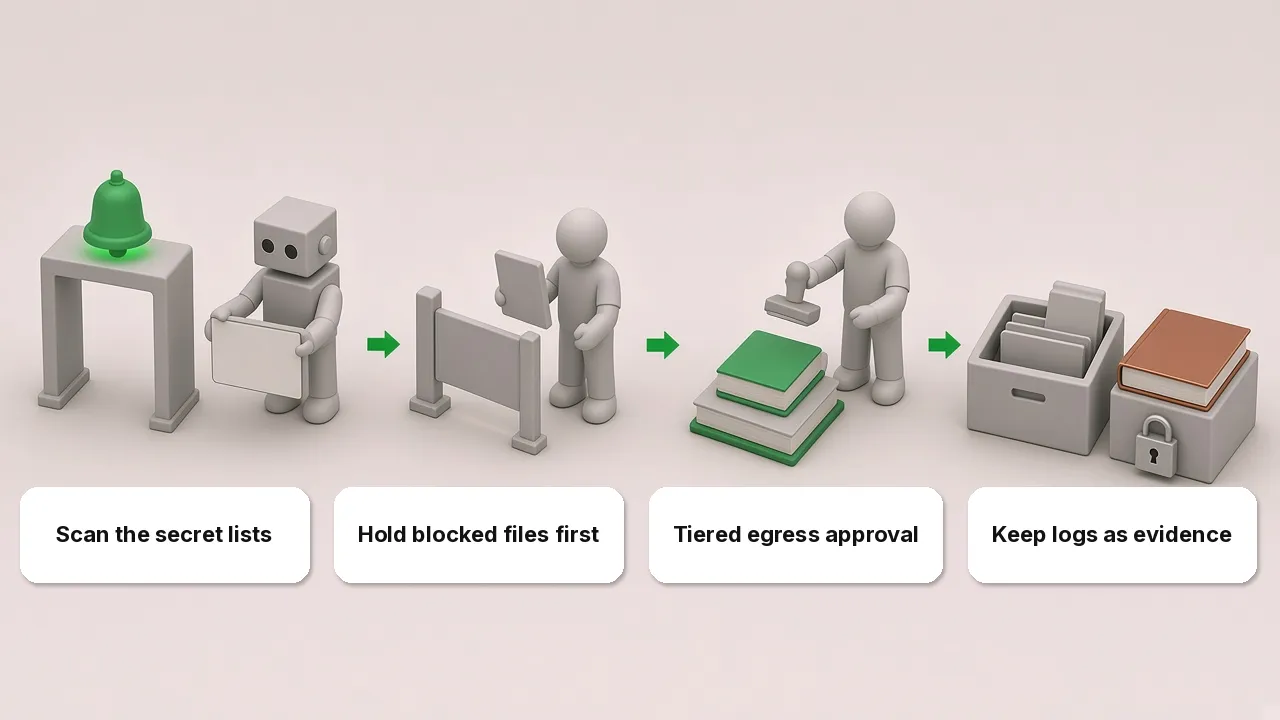
Companies configure scanning rules on email, shared links, and messaging channels to inspect trade-secret egress, placing blocked files on hold for sender context and tiered egress approval.

When trade-secret egress is blocked by a channel scan, the system places the transfer on hold without deleting the file or issuing an immediate disciplinary notice. The sender adds the recipient identity, non-disclosure agreement status, and business purpose, and the request then goes through tiered egress approval by sensitivity level. Department heads approve general internal documents, while the data owner and legal approve core technology and formulas together. Approved releases can carry watermarks, time-limited links, or only the necessary pages. All scan, block, and approval logs are retained as evidence that the company took confidentiality measures, and high-false-positive rules are tuned monthly.
How scanning rules identify trade secrets
Companies configure AI scanning across outbound channels such as corporate email, cloud drive shared links, and instant messaging to watch drawings, price quotes, process formulas, and customer lists sent to customers or suppliers. Employees pasting contracts into external chat tools falls under a separate workflow; see Should You Paste a Contract into ChatGPT? Redact It First. This note covers blocking and releasing files on outbound company channels.
Under Article 10 of the PRC Anti-Unfair Competition Law, effective October 15, 2025, trade secrets refer to technical information, operational information, and other commercial information that is not known to the public, has commercial value, and for which the right holder has taken corresponding confidentiality measures. AI scanning rules on outbound channels come from the company’s own classification list rather than leaving AI to guess what counts as a secret. Legal and business departments first define which drawings, formulas, price quotes, and customer lists count as trade secrets, and AI matches outgoing files against the classification list and file labels.
Place blocked files on hold and add context
When an employee sending a quote to a customer or a drawing to a contract manufacturer gets blocked, the channel places the outbound transfer on hold without deleting the file or broadcasting a violation notice, so business staff do not bypass company channels and send files privately out of fear of being written up.
The sender can see the specific reason for the block, such as which file label or keyword pattern matched. After confirming that the transfer is part of normal business, the sender fills in three items on the hold ticket:
- Recipient identity: state which customer or supplier is receiving the file, and check that the recipient’s email address or account domain matches the contracting entity.
- Non-disclosure agreement status: state whether the two sides have signed a non-disclosure agreement or whether the master contract includes a confidentiality clause.
- Purpose and scope of egress: explain what the file is being sent for, such as quoting, sampling, delivery, or reconciliation, and confirm that no extra material is attached.
Tiered egress approval by classification and release controls
Once the sender submits the context, the ticket enters the egress approval workflow. Under Article 10 of the PRC Anti-Unfair Competition Law, disclosing, using, or allowing others to use trade secrets in one’s possession in breach of confidentiality obligations or the right holder’s requirements for keeping trade secrets confidential constitutes infringement of trade secrets. The company routes egress approval by classification tier to different roles, using tier criteria set by the company itself:
- General internal documents: routine price quotes, standard project schedules, and draft proposals are approved by the department head after checking the business context.
- Core technology and formulas: core design drawings, process formulas, source code, and full customer lists are approved jointly by the data owner and legal.
When approving a release, the approver can require adding a watermark, switching to a time-limited link, or sending only the necessary pages. If the outgoing file also contains customer personal data, handle it under personal data minimization rules as well; see Personal Data Agents: How Far Can Customer Data Go?. Where the approver finds that no non-disclosure agreement is in place, the recipient account looks questionable, or sending the original file is unnecessary, the approver rejects the request and records the reason.
Retaining block and approval logs and tuning rules monthly
Every scan, block, and egress approval record is retained. Under Article 39 of the PRC Anti-Unfair Competition Law, in civil proceedings for trade-secret infringement, where the trade-secret right holder provides preliminary evidence showing that it has taken confidentiality measures for the claimed trade secret and reasonably indicates that the trade secret has been infringed, the alleged infringer must prove that the trade secret claimed by the right holder does not fall within the trade secrets defined by this Law. Keeping classification lists, scan and block logs, and egress approval tickets in daily operations helps show that the company took confidentiality measures.
The information security team reviews block logs alongside approval outcomes; if a rule generates frequent false positives where routine public materials are repeatedly blocked and then released, legal, business, and information security adjust the scanning rules and classification list together on a monthly cadence.
Trade-secret egress: FAQ
What if a trade-secret egress block hits an urgent business file?
The sender fills in the recipient identity, whether a non-disclosure agreement is signed, and the business purpose on the hold ticket, and alerts the approver for expedited handling. General internal documents are released after the department head checks them; for core technology and formulas, the sender can prepare a version with a watermark, a time-limited link, or only the necessary pages for joint approval by the data owner and legal, rather than bypassing company channels to send files privately.
Does sending a file to a supplier under a signed NDA still require approval?
Yes, it still follows the classification list and channel rules. Noting the signed non-disclosure agreement on the hold ticket helps the approver verify the background, while questions such as whether a drawing or formula only includes the necessary pages, or whether to add a watermark or use a time-limited link, still go through tiered approval under the company’s classification rules, with the record retained.
How long should egress approval records be kept?
The company sets the retention period based on its contracts and internal policies. Because egress approval records, together with scan and block logs, can be used to show that the company took confidentiality measures for its trade secrets, legal and information security teams typically archive these records alongside the corresponding contracts and project files so they can be retrieved for future audits or evidence.